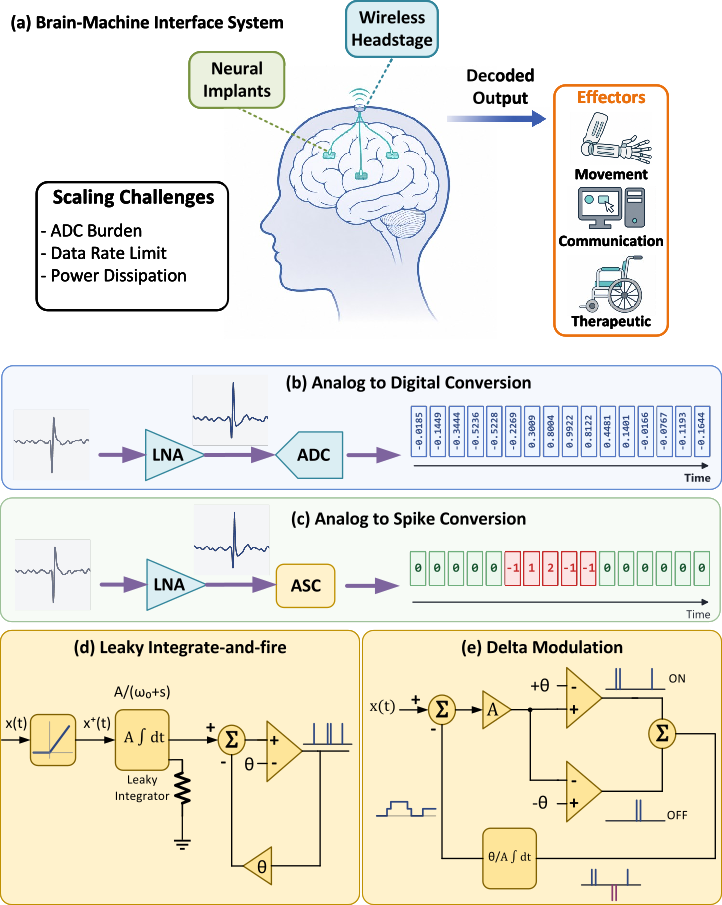
Published - Scientific Reports 2025
Posted on: 2025
Event driven neural network on a mixed signal neuromorphic processor for EEG based epileptic seizure detection

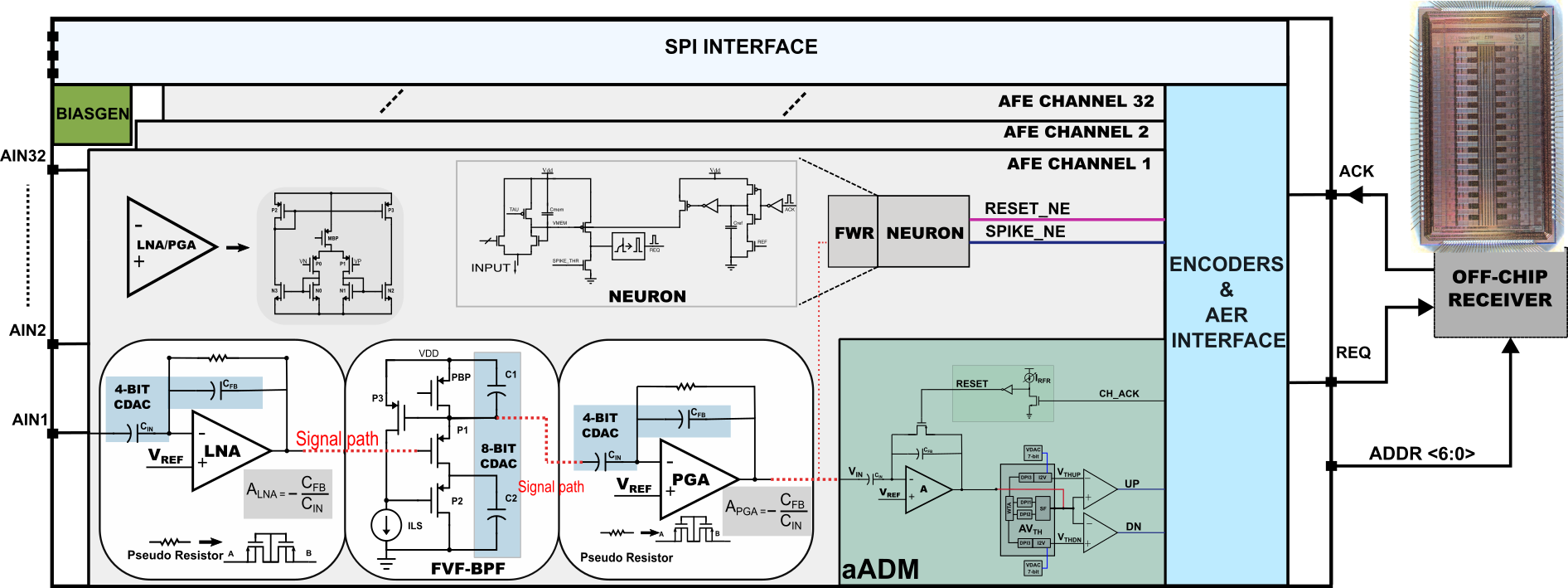
Long-term monitoring of biomedical signals is essential for the modern clinical management of neurological conditions such as epilepsy. However, developing wearable systems, able to monitor, analyze, and detect epileptic seizures with long-lasting operation times, using current technologies is still an open challenge. Brain-inspired spiking neural networks (SNNs) represent a promising signal processing and computing framework as they can be deployed on ultra-low power neuromorphic computing systems, for this purpose. Here, we introduce a foundational SNN architecture, co-designed and validated on a mixed-signal neuromorphic chip, for always-on monitoring of epileptic activity. We demonstrate how the hardware implementation of this SNN captures the phenomenon of partial synchronization within neural activity during seizure periods. We benchmark the network using a full-custom asynchronous mixed-signal neuromorphic platform, processing analog signals in real-time from an Electroencephalographic (EEG) seizure dataset. The neuromorphic chip comprises an analog front-end (AFE) signal conditioning stage and an asynchronous delta modulation (ADM) circuit directly integrated on the same die, which can produce the stream of spikes as input to the SNN, directly from the EEG electrodes. A linear classifier in a post processing stage is sufficient to reliably classify and detect seizures, from the local features extracted by the SNN. This research marks a significant advancement toward developing embedded intelligent "wear and forget" units for resource-constrained environments. These units could autonomously detect and log relevant EEG events of interest in out-of-hospital environments, offering new possibilities for patient care and management of neurological disorders.
Read More
Tweet
Published - Scientific Reports 2025
Posted on: 2025
Amplitude entropy captures chimera resembling behavior in the altered brain dynamics during seizures

Epileptic seizures are characterised by pronounced amplitude changes across EEG channels that are not captured by existing phase-based measures. We propose Amplitude Entropy (AE) - a frequency- and time-resolved Shannon entropy over the Hilbert-derived analytic amplitude distribution across iEEG channels - as a novel marker of amplitude chimera-like states during seizures. Tested on 100 seizures from 16 focal epilepsy patients in the public SWEC-ETHZ iEEG database, AE shows statistically significant increases during seizure versus pre- and post-seizure across all frequency bands (delta through high-gamma), robust after Bonferroni correction. A local AE peak at seizure onset and a subsequent plateau suggest network recruitment from a focal onset zone into a wider brain network. AE effects are strongest in temporal lobe epilepsy patients with positive MRI findings and in patients with better surgical outcomes, linking this computationally lightweight measure to clinically meaningful variables. AE offers a simpler, real-time-feasible alternative to phase estimation for seizure characterisation and potential patient classification.
Read More
Tweet
Accepted - IEEE ISCAS 2026
Posted on: 2026
Toward Generative Silicon: The Next Frontier in Open-Source and AI-Driven Analog Design
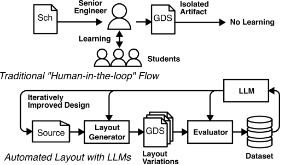
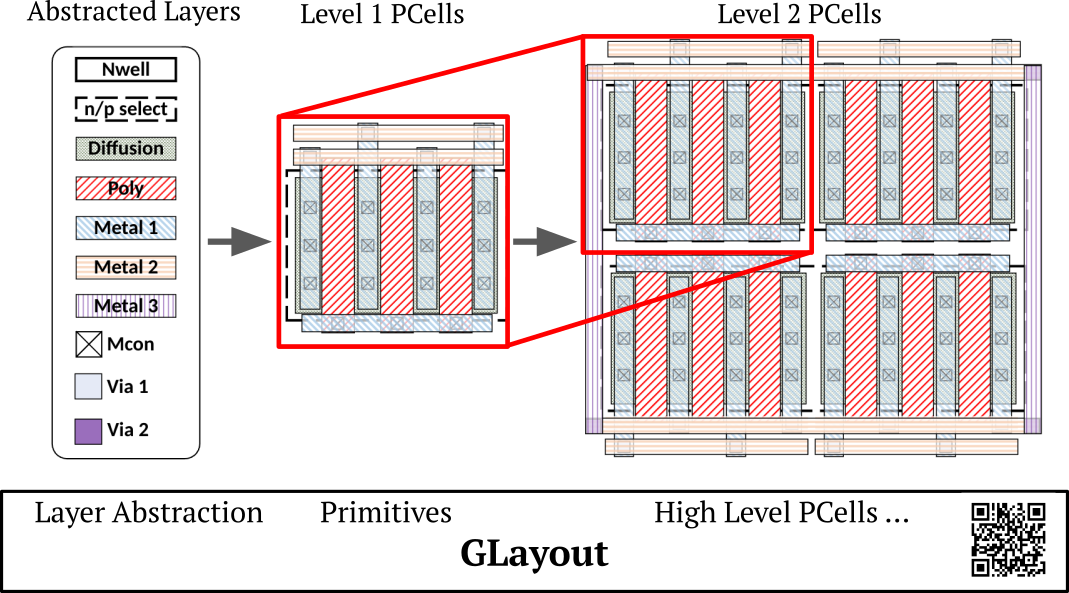
Analog and mixed-signal (AMS) design remains the primary bottleneck in modern IC flows: unlike digital, it lacks standardised, machine-readable representations that would enable scalable automation or meaningful dataset accumulation. This position paper argues that programmatic layout frameworks - expressing circuits as structured code rather than fixed geometry - are a necessary prerequisite for AI-driven generative design. Using gLayout as a running example, we show how code-based representations unlock versioning, parametric variation, and reproducibility, creating the conditions for LLM-assisted closed-loop design iteration. We outline the key remaining challenges: automated verification beyond DRC/LVS, trustworthy evaluation of AI-generated analog layouts, and the absence of open curated training datasets with embedded design intent. A proposed dataset schema combining source files, DRC/LVS status, parasitic extraction, and SPICE testbench metrics is presented. The paper calls for open-source PDKs and EDA infrastructure as a community foundation on which shared benchmarks and generative models for analog layout can be built.
Conference Link
Tweet
Open Dataset
Posted on: 2024
Spiking Seizure Classification Dataset

Dataset for event encoded analog EEG signals for detection of epileptic seizures. This dataset contains events that are encoded from the analog signals recorded during pre-surgical evaluations of patients at the Sleep-Wake-Epilepsy-Center (SWEC) of the University Department of Neurology at the Inselspital Bern. The analog signals are sourced from the SWEC-ETHZ iEEG Database. This database contains event streams for 10 seizures recorded from 5 patients and generated by the DYnamic Neuromorphic Asynchronous Processor (DYNAP-SE2) to demonstrate a proof-of-concept of encoding seizures with network synchronization. The pipeline consists of two parts: (I) an Analog Front End (AFE) and (II) an SNN termed as "Non-Local Non-Global" (NLNG) network.
Read More
Tweet
Preprint
Posted on: 2024
An event-driven neural network for monitoring of epileptic seizures on low-power neuromorphic hardware

Long-term monitoring of biomedical signals is essential for the modern clinical management of neurological conditions such as epilepsy. However, developing wearable systems, able to monitor, analyze, and detect epileptic seizures with long-lasting operation times, using current technologies is still an open challenge. Brain-inspired spiking neural networks (SNNs) represent a promising signal processing and computing framework as they can be deployed on ultra-low power neuromorphic computing systems, for this purpose. Here, we introduce a foundational SNN architecture, co-designed and validated on a mixed-signal neuromorphic chip, for always-on monitoring of epileptic activity. We demonstrate how the hardware implementation of this SNN captures the phenomenon of partial synchronization within neural activity during seizure periods. We benchmark the network using a full-custom asynchronous mixed-signal neuromorphic platform, processing analog signals in real-time from an Electroencephalographic (EEG) seizure dataset. The neuromorphic chip comprises an analog front-end (AFE) signal conditioning stage and an asynchronous delta modulation (ADM) circuit directly integrated on the same die, which can produce the stream of spikes as input to the SNN, directly from the EEG electrodes. A linear classifier in a post processing stage is sufficient to reliably classify and detect seizures, from the local features extracted by the SNN. This research marks a significant advancement toward developing embedded intelligent "wear and forget" units for resource-constrained environments. These units could autonomously detect and log relevant EEG events of interest in out-of-hospital environments, offering new possibilities for patient care and management of neurological disorders.
Read More
Tweet